
A crypto address tells the network where to send funds. Each network has its own format, and many formats include a checksum that catches typos. Learning to recognise them takes five minutes and prevents most payout mistakes.
Address formats at a glance
| Network | Starts with | Length | Example (shortened) |
|---|---|---|---|
| Bitcoin (native SegWit) | bc1q | 42 or 62 | bc1q3fpa…dmzl |
| Bitcoin (Taproot) | bc1p | 62 | bc1p… |
| Bitcoin (older) | 1 or 3 | 26 to 35 | 3J98…WNLy |
| Ethereum and every EVM network | 0x | 42 | 0x4D7a…df15 |
| TRON (TRX, USDT TRC20) | T | 34 | TXkA…bTYaz |
| Solana | no fixed prefix | 32 to 44 | 74uv…VziA |
| XRP Ledger | r | 25 to 35 | rf1B…2Jpn |
| XRP X-address | X | 47 | X7qv…PHEW |
| Monero main address | 4 | 95 | 47rH…YJ8 |
| Monero subaddress | 8 | 95 | 86eH…432t |
| Litecoin | ltc1, L or M | 26 to 63 | LNBP…TPcEp |
| Dogecoin | D | 34 | DBaC…VatU |
| Bitcoin Cash | bitcoincash:q or q | 42 to 54 | qqrg…xcja |
| TON | UQ or EQ | 48 | EQCK…JgZg |
| Zcash (transparent) | t1 or t3 | 35 | t1V9…L2RC |
Only EVM networks (Ethereum, Polygon, BNB Smart Chain, Arbitrum, Base, Optimism, Linea, Avalanche, Berachain, Monad…) share one format. That's why a single EVM wallet covers all of them.
Checksums: built-in typo protection
- Bitcoin, Litecoin, Bitcoin Cash (
bc1,ltc1,q…) use a checksum that rejects almost any typo. - Ethereum addresses use upper and lower case letters as a checksum (EIP-55). Keep the capitals exactly as copied.
- TRON, Dogecoin, XRP, Monero use base58 encodings with a checksum.
- Solana addresses have no checksum: a typo can produce a valid but wrong address. Always copy and paste.
Memos and destination tags
Some networks let one address serve many people, with a number or text to say who a payment is for:
- XRP destination tags: PayGate.to accepts
r…?dt=TAGand X-addresses. See Get an XRP address with a destination tag. - TON comments and other memos: used by some custodial services.
Your own self-custodial wallet never needs a tag or memo.
Five checks before using an address
- Right network: the format matches the field it goes into.
- Copied, not typed: use the wallet's copy button or QR code.
- First and last six characters match what the wallet shows.
- No extra spaces at the start or end.
- A small test first for large amounts.
PayGate.to rejects addresses for the wrong coin
When a payment address is created, PayGate.to checks that your payout wallet is valid for the selected coin. In this test we entered a Bitcoin address as the payout wallet for XRP in the crypto forwarding address generator, and it was refused:
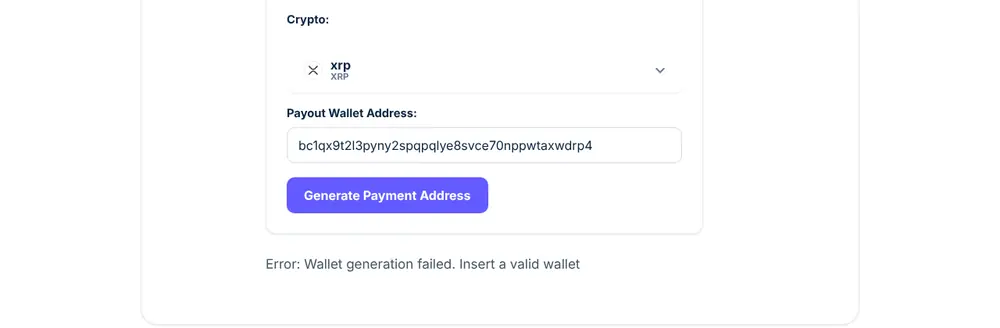
This catches wrong-network mistakes, but not a valid address that isn't yours, so always copy the address from your own wallet.
Frequently asked questions
Can I reuse the same address?
Yes. Addresses don't expire. Reusing one links all its payments together publicly on transparent networks, which some people avoid for privacy. Monero is private either way.
Why does my wallet show a different Bitcoin address every time?
Many Bitcoin wallets show a fresh address for privacy. All of them belong to your wallet; any of them can receive.
Is it safe to share my address publicly?
Yes, it's meant to be shared. On transparent networks anyone can see its balance and history, so use a separate address for business if you want to keep personal funds private.